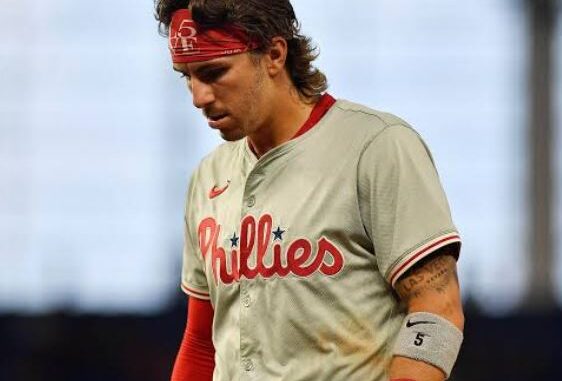
The Philadelphia Phillies entered their September series against the Washington Nationals under increasing pressure to find consistency at the plate and gain ground in the National League playoff race. After an uneven stretch following their outstanding August, Philadelphia made a subtle but noteworthy adjustment to its lineup Wednesday, moving Bryson Stott up one spot in the batting order. The change came as the Phillies turned to Zack Wheeler for the series finale, making the lineup tweak particularly interesting with the club needing a strong response after dropping the opener.
Stott had been batting seventh in Tuesday’s series opener, but the Phillies moved him into the No. 6 spot for Wednesday’s game. It was not a dramatic overhaul of the lineup, but it represented another attempt by interim manager Don Mattingly to maximize the production of a group that had struggled to maintain its August offensive rhythm. Philadelphia had gone 21-6 in August, but September had brought a noticeably different stretch, increasing the importance of small lineup decisions as the postseason approached.
The timing of the move was significant because Philadelphia desperately needed a response after Tuesday’s 6-3 loss to Washington. That defeat prevented the Phillies from gaining ground in the NL East and added to the pressure surrounding their Wild Card position. The club’s primary objective had increasingly shifted toward securing the strongest possible Wild Card position, making every remaining game increasingly important.
Stott Gets a Slightly Bigger Offensive Role
Stott’s promotion was particularly notable because the Phillies generally do not make major lineup changes from game to game. Moving him from seventh to sixth was therefore a relatively modest adjustment, but it gave him an opportunity to hit earlier and potentially receive more favorable run-producing opportunities.
The second baseman had quietly produced a solid overall season despite not putting up the kind of headline numbers associated with some of Philadelphia’s biggest stars. Entering Wednesday, Stott had appeared in 144 games and collected 124 hits, 28 doubles and six triples. He had also recorded 10 home runs, 65 runs scored and 63 RBIs while hitting .248.
Those numbers help explain why the Phillies could view Stott as an important piece of their offensive structure. His value is not limited to home-run production. His ability to contribute with doubles, triples, contact and situational hitting gives Philadelphia another potential source of offense behind its established stars.
That becomes especially important during a postseason race in which the Phillies cannot afford to rely exclusively on Kyle Schwarber, Bryce Harper or Trea Turner to carry the offense. When those hitters are contained, Philadelphia needs production from players such as Stott, Alec Bohm and the rest of the supporting cast.
The Move Comes During a Difficult September
The lineup adjustment also came against the backdrop of a difficult month for Philadelphia. The Phillies had established significant momentum during August, but their September results had not matched that performance. The Heavy report noted that the team had not enjoyed the same level of success in September after its remarkable August run.
The Nationals series illustrated that inconsistency. Philadelphia dropped the opener 6-3 before responding with a 3-0 victory Wednesday. The second game featured a completely different pitching performance, with Wheeler dominating Washington and giving the Phillies the kind of stability they needed.
Wheeler worked seven scoreless innings, allowing four hits while striking out five and walking one. Philadelphia eventually secured the shutout, with the offense doing just enough to support its ace. The Phillies also drew 13 walks in the game, showing a much more patient approach even though they finished with only five hits.
Stott’s lineup promotion therefore occurred within a broader effort to generate more consistent offense. The Phillies were not simply changing one player’s position in the order; they were attempting to squeeze more production from an offense entering the most important portion of the season.
Stott’s Importance Could Increase
With October approaching, Stott could become an increasingly important part of Philadelphia’s lineup. His ability to play second and third base provides defensive flexibility, while his offensive production gives the Phillies another middle-of-the-order-adjacent option when the lineup is fully healthy.
His season statistics also show that he has provided steady production over a long sample. Ten home runs may not appear overwhelming compared with Philadelphia’s power hitters, but his 28 doubles, six triples, 63 RBIs and 124 hits demonstrate a broader offensive contribution.
The Phillies will need that type of balanced production if they want to avoid becoming too dependent on their biggest stars. Postseason games frequently come down to individual opportunities, and a hitter moving up even one spot can receive additional plate appearances or encounter different game situations.
That makes Mattingly’s decision worth watching even though it was not a major lineup overhaul.
The Bigger Phillies Picture
The Stott adjustment is only one piece of a much larger Philadelphia storyline. The Phillies are simultaneously trying to stabilize their offense, bullpen and rotation while navigating the absence of Jesús Luzardo.
Luzardo was placed on the 15-day injured list with left shoulder inflammation before the Nationals series. The move came after he was scratched from his scheduled start against Atlanta because of shoulder stiffness. The Phillies remain hopeful that he can return for the postseason, but his absence creates another question for a rotation that is already under pressure.
That makes Wheeler’s performance against Washington especially valuable. Philadelphia needs its established starters to provide length and consistency while the team works through its pitching uncertainty. At the same time, the offense must become more dependable.
Stott’s lineup promotion should therefore be viewed as a small tactical adjustment rather than a dramatic change. But with the postseason approaching, even small decisions can carry greater significance.
For Stott, the message is relatively straightforward: Philadelphia continues to view him as an important offensive piece, and the club is willing to move him around the batting order in search of the right combination.
The Nationals series ultimately produced both sides of the Phillies’ current situation. Tuesday’s loss highlighted their inconsistency, while Wednesday’s 3-0 victory showed what can happen when the pitching controls the game and the lineup creates enough opportunities. Stott’s move up the order was another small attempt to find that balance as Philadelphia heads deeper into the playoff race.
Leave a Reply