The Chicago Cubs walked away from Monday night’s series opener against the Arizona Diamondbacks with a convincing 7-0 victory, but the biggest talking point after the game had little to do with the final score.
Instead, attention centered on a heated exchange between the two coaching staffs after Arizona accused Cubs third-base coach Quintin Berry of attempting to steal signs and relay pitch information to Chicago hitters.
From the box score alone, the game looked routine. Kevin Gausman delivered a strong performance on the mound, while Michael Conforto helped power the offense with a three-hit night. But anyone watching the game closely saw tensions rise in the middle innings as members of both dugouts exchanged words.
The confrontation reportedly began after the Diamondbacks believed Berry was attempting to get information about Merrill Kelly’s pitch selection. Arizona suspected that Berry was able to identify Kelly’s changeup and communicate that information to Cubs hitters.
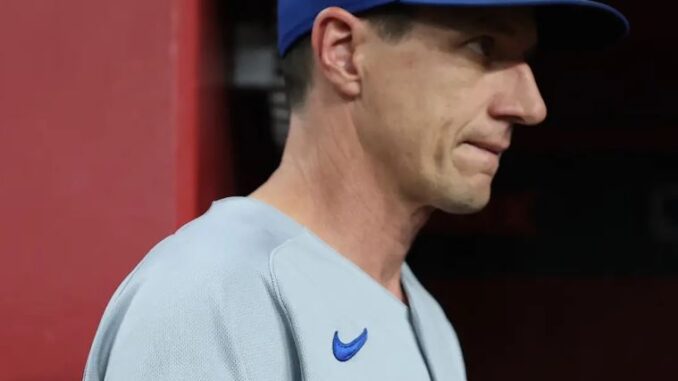
Rather than treating the incident as a major controversy, Cubs manager Craig Counsell offered a remarkably calm assessment.
Counsell essentially dismissed the confrontation as part of the competitive nature of Major League Baseball, describing it as “gamesmanship that goes on every day in the league.”
That response may not have done much to cool the situation from Arizona’s perspective, especially with the Diamondbacks fighting desperately to remain in the National League playoff race. Every game carries increased importance at this point of the season, and a matchup against one of the teams currently occupying a Wild Card position only adds to the pressure.
Why Arizona was upset
The Diamondbacks’ frustration centered on the belief that Berry was doing more than simply observing the game from the third-base coaching box.
Kelly is particularly dependent on his changeup, making it one of the most important pitches in his arsenal. If opposing hitters know when that pitch is coming, even without using electronic technology, it can potentially give them an advantage.
Kelly ultimately threw the pitch often, but Chicago still managed to put pressure on him throughout the night. The Cubs scored three runs against the veteran right-hander over five innings and drove his pitch count upward.
Kelly threw 99 pitches, with more than half reportedly missing the strike zone. Chicago also produced a key RBI triple from Pedro Ramirez on a changeup, adding another layer to Arizona’s frustration.
From the Cubs’ perspective, however, the situation did not appear to cross any clear competitive boundary. Sign stealing itself has been part of baseball for generations, although MLB has increasingly drawn distinctions between information obtained through normal observation and information acquired through prohibited technology.
Counsell keeps the temperature down
Counsell’s response was notable because he could easily have allowed the incident to become a larger storyline. Instead, he effectively treated it as another example of two competitive teams trying to gain an edge.
That approach fits with the Cubs manager’s reputation for avoiding unnecessary drama and keeping his focus on the larger picture. Chicago has bigger objectives than winning a verbal confrontation in the dugout.
The Cubs are currently sitting in a strong position in the National League playoff race, and Monday’s win gave them another important victory as the regular season moves toward its final month.
Arizona, meanwhile, entered the series with considerably more urgency.
The Diamondbacks were only two games outside the playoff picture, with the Miami Marlins and St. Louis Cardinals also lurking behind them. With the Cubs holding the top Wild Card position, taking games directly from Chicago could have enormous implications for Arizona’s postseason chances.
That context likely contributed to the intensity on Monday night.
Cubs have bigger goals than the controversy
While the sign-stealing dispute provided plenty of entertainment, the Cubs’ performance on the field was far more important.
Chicago controlled the game from beginning to end, shutting out Arizona and continuing to strengthen its position in the National League Wild Card race. The Cubs entered Tuesday with a three-game cushion over the Philadelphia Phillies for the top Wild Card spot, while San Diego occupied the final Wild Card position.
With several teams still within striking distance, Chicago cannot afford to become distracted by unnecessary confrontations.
The victory also gave the Cubs momentum after a difficult stretch against Seattle. Chicago had lost the first two games of its series against the Mariners before exploding for a 19-2 victory in the finale. The Cubs then carried that offensive momentum into Arizona.
Could the drama carry over?
The biggest question now is whether Monday’s confrontation was simply a one-night incident or whether it could add another layer of intensity to the remainder of the series.
The Cubs and Diamondbacks were scheduled to meet again Tuesday, with Clay Holmes expected to face Brandon Pfaadt. Given the playoff implications surrounding both clubs, another competitive and emotional game would not be surprising.
Arizona needs victories to close the gap in the Wild Card race, while Chicago is trying to protect its position and establish itself as one of the National League’s strongest postseason contenders.
For now, Counsell appears uninterested in making the sign-stealing dispute bigger than it needs to be. His message was essentially that baseball is a competitive game, teams constantly look for advantages, and some heated exchanges are simply part of the sport.
The Diamondbacks may disagree with that interpretation, but Chicago has the one thing that matters most at the end of the night: a 7-0 victory and another valuable win in a tightly contested National League playoff race.
Leave a Reply