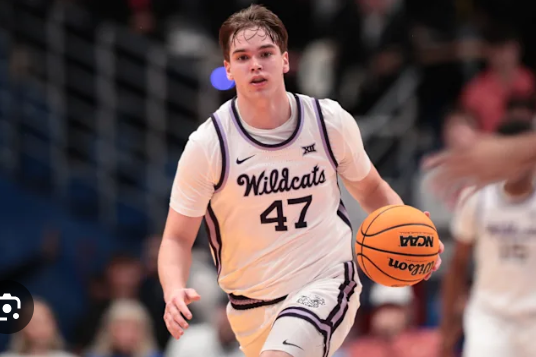
When Andrej Kostic arrived in Manhattan, expectations followed him across the Atlantic. The Serbian freshman had already built a reputation as a polished perimeter scorer with advanced offensive instincts, and many evaluators believed his shooting touch and feel for the game could eventually make him an NBA prospect. Yet his first season with the Kansas State Wildcats men’s basketball never fully ignited.
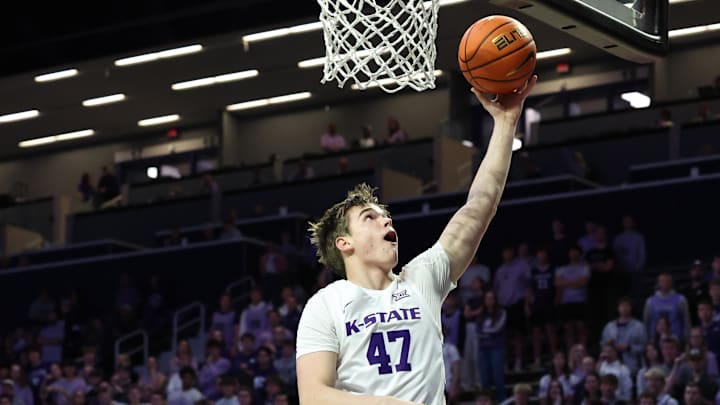
Instead of becoming an immediate breakout star, Kostic spent much of the 2025–26 season trying to carve out a consistent role in a turbulent year for the Wildcats. He averaged just 5.2 points and 1.7 rebounds across 23 appearances, often playing in short stretches and struggling to establish rhythm. Still, beneath those modest numbers were flashes of the player Kansas State believed it had recruited a confident shooter capable of stretching defenses the moment he crossed half court.
Now, with Casey Alexander taking over the program after the dismissal of Jerome Tang, Kostic suddenly finds himself in a dramatically different basketball environment one that may perfectly complement his strengths.
Alexander’s arrival signals more than a coaching change; it represents a philosophical reset. Known for his high-tempo, perimeter-oriented offensive systems, Alexander has built a reputation for empowering shooters and creating spacing-heavy attacks that emphasize freedom, pace, and confidence. At Belmont, his teams consistently ranked among the nation’s best outside-shooting squads. Last season alone, Belmont launched an astonishing 819 three-pointers while shooting 41% from beyond the arc, numbers that illustrate exactly the kind of aggressive offensive identity Alexander wants to bring to Manhattan.
For a player like Kostic, that system could be transformative.
Unlike the previous structure, where minutes and opportunities often fluctuated, Alexander immediately made it clear that he viewed Kostic as a foundational piece rather than a developmental afterthought. Shortly after being hired, the new coaching staff prepared detailed film sessions specifically designed to show Kostic how he would fit into the Wildcats’ future.
Alexander’s message was direct: this could be a fresh start.
Rather than asking Kostic merely to adapt, the staff emphasized how the offense could amplify the very skills that once made him one of Europe’s intriguing young scorers. The conversations apparently resonated. At a time when Kansas State’s roster was rapidly disintegrating through the transfer portal — with nine players departing and several landing at other power-conference programs Kostic became the lone returning scholarship player from the previous core.
That decision says a great deal about both player and coach.
For Kostic, staying meant resisting the increasingly common instinct to immediately transfer after adversity. It suggested belief: belief in his own untapped potential, belief in Alexander’s vision, and belief that Manhattan still offered the right environment for his growth. Alexander himself acknowledged that local support played a major role, praising the community for making Kostic feel valued despite an uneven freshman campaign.
That emotional connection matters more than many realize in modern college basketball. International players often face enormous transitions new language, culture, style of play, and expectations all while adapting to the relentless speed and physicality of American college hoops. Confidence can become fragile when production doesn’t immediately match hype. For Kostic, remaining at Kansas State may provide the stability needed to finally settle into his game.
And there are legitimate reasons to think his breakthrough could happen quickly.
The raw shooting numbers already hint at his upside. Kostic connected on 37.5% of his three-point attempts last season, hitting 30 triples despite inconsistent minutes. His most memorable performances came in major moments, including a four-three-pointer outing against rival Kansas Jayhawks men’s basketball. Those flashes demonstrated that his confidence does not shrink under pressure.
More importantly, his role expanded late in the season under interim coach Matthew Driscoll. Over his final seven games, Kostic averaged 7.4 points, showing increased aggression and comfort offensively. The improvement suggested that rhythm and trust were critical missing ingredients.
Alexander’s offense could provide both.
In a system built around ball movement and perimeter spacing, Kostic may no longer be forced into hesitant spot-up opportunities. Instead, he could become an active offensive weapon — running off screens, operating in transition, and receiving the green light to shoot without overthinking. Belmont’s previous success with guards like Tyler Lundblade demonstrates how productive perimeter scorers can become within Alexander’s structure.
Of course, offensive promise alone will not guarantee a starring role. Defense remains the major question surrounding Kostic’s development. To earn extended minutes in the rugged Big 12 Conference, he must improve physically and become more reliable on that end of the floor. Alexander’s teams traditionally demand energy and discipline defensively to fuel their transition attack.
But if Kostic can make even moderate strides there, the offensive ceiling becomes extremely intriguing.
Kansas State fans may finally see the version of Kostic they imagined when he first arrived from Serbia — a fearless shooter capable of changing games with quick scoring bursts and stretching defenses far beyond the arc. In many ways, the timing of Alexander’s arrival may have rescued a talented player from becoming lost in transition.
Instead of starting over elsewhere, Andrej Kostic now has an opportunity to reinvent himself exactly where his college career began. And under a coach whose philosophy naturally aligns with his skill set, the sophomore guard could emerge as one of the Wildcats’ most important pieces in the program’s new era.
Leave a Reply