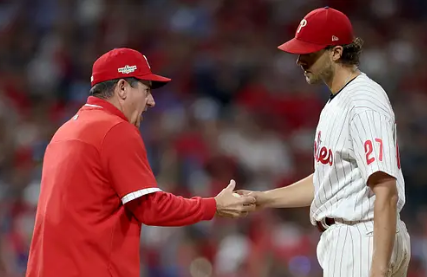
The Philadelphia Phillies are facing a growing dilemma with veteran starter Aaron Nola, whose continued struggles have become one of the team’s biggest concerns despite the massive financial commitment remaining on his contract. While the organization recently sent top prospect Andrew Painter back to the minor leagues after an inconsistent start to his rookie campaign, the Phillies do not have the same flexibility when it comes to Nola, a franchise cornerstone who remains under contract through the 2030 season.
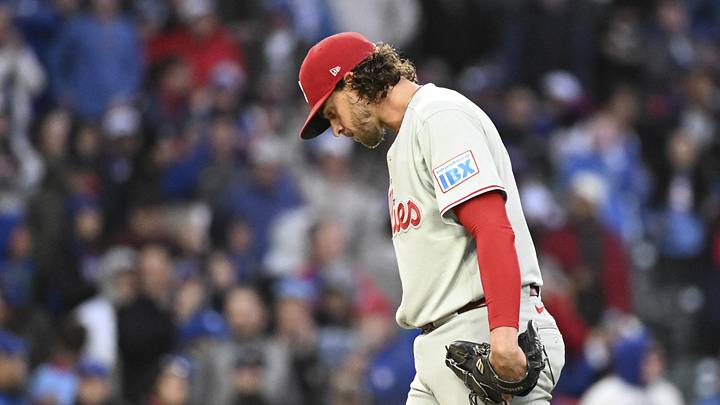
Nola’s latest rough outing, which included surrendering two home runs to Mets superstar Juan Soto, further highlighted a troubling trend that has persisted for more than a year. The right-hander currently owns a 5.71 ERA through 15 starts and 75.2 innings in 2026, numbers that fall well below the expectations attached to one of the largest contracts in franchise history.
The situation becomes even more concerning when viewed in the context of Nola’s recent performance. After posting a 6.01 ERA in 17 starts during the 2025 season, the veteran has been unable to rediscover the consistency that once made him one of baseball’s most dependable frontline starters. Although the first year of his seven-year, $172 million extension showed encouraging signs, his production has declined significantly since then, leaving the Phillies with difficult questions about their rotation moving forward.
Financially, the stakes are enormous. Nola is scheduled to earn approximately $24.5 million annually through 2030, meaning Philadelphia still owes him nearly $98 million over the final four years of the deal. That sizeable commitment limits the club’s options, especially as it battles for playoff positioning and attempts to keep pace in a competitive National League East race.
Despite the disappointing results, Nola’s value to the franchise cannot be overlooked. Over 12 major league seasons—all spent in Philadelphia—he has made exactly 300 starts while compiling a solid 3.91 career ERA. A former All-Star and one of the most accomplished pitchers in modern Phillies history, Nola has also delivered several memorable postseason performances that helped establish his legacy within the organization.
The debate surrounding Nola has therefore become increasingly complex. On one hand, he continues to provide durability, taking the ball every fifth day and helping preserve the bullpen by consistently logging innings. On the other hand, his inability to prevent runs has repeatedly placed Philadelphia in early deficits, creating added pressure on both the offense and relief corps during a crucial stage of the season.
As the Phillies evaluate potential roster upgrades and rotation adjustments, Aaron Nola’s contract and performance remain at the center of the conversation. With nearly $100 million still owed and playoff aspirations on the line, the organization must determine whether the veteran can regain the form that once made him one of the most reliable pitchers in baseball—or whether his decline represents a longer-term challenge for the franchise.
Leave a Reply