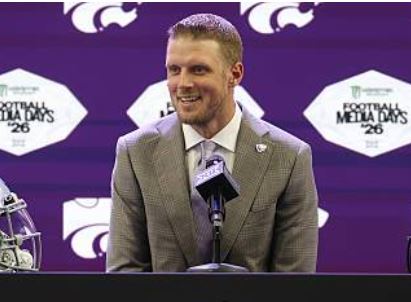
Kansas State football officially entered a new era Monday as first-year head coach Collin Klein met with the media ahead of the Wildcats’ season-opening matchup against Nicholls. While the press conference marked an important milestone in Klein’s return to Manhattan as the program’s head coach, much of the discussion centered on roster development, offensive-line injuries, position battles and the expectations surrounding a dramatically revamped Kansas State team. The Wildcats will host Nicholls on Saturday, Sept. 5, at Bill Snyder Family Stadium, with kickoff scheduled for 6 p.m. CT on ESPN+.

Offensive Line Injuries Become Early Concern
One of the biggest takeaways from Klein’s opening press conference was the uncertainty surrounding the offensive line. Kansas State has been forced to move several players around because injuries have disrupted the plans established during preseason camp. Klein acknowledged that the group has not developed exactly as the coaching staff expected, making the early-season competition particularly important. Oliver Miller, who had a strong camp and appeared capable of giving the unit a boost, is now expected to miss several weeks. Tanner Morely is also dealing with an injury but remains considered day-to-day. The Wildcats had already announced that two offensive linemen would miss the entire 2026 season, adding to the challenge of building continuity up front.
Despite those setbacks, Klein expressed confidence in players who have taken advantage of their opportunities. Charlie Adams and Chase Duarte, both guards, have reportedly made significant progress since arriving at Kansas State in January. Keiton Jones has also impressed during camp, particularly with his understanding of the offense and physical development. Dylan Villarouel has emerged as an important presence at center, with Klein highlighting his leadership growth and overall skill set. The situation means Kansas State could enter the season relying on a combination of young players and newcomers to stabilize one of the most important units on the field.
Avery Johnson Remains the Offensive Headliner
At quarterback, the Wildcats continue to revolve around Avery Johnson, who is preparing to make his third consecutive season-opening start. That achievement places him alongside Skylar Thompson and Jesse Ertz as the only Kansas State quarterbacks since 1990 to start at least three straight season openers. Johnson is also expected to make his 27th career start against Nicholls, giving the Wildcats an experienced leader despite the number of new faces surrounding him.
Klein’s message to Johnson appears straightforward: play fast, remain confident and allow his competitive personality to show. The coach wants the quarterback to operate decisively rather than become overwhelmed by the pressure that naturally comes with being the face of a new era. Behind Johnson, Blake Barnett and Dillon Duff provide additional depth, with Duff having emerged as an intriguing young option after a strong development period.
K-State Still Sorting Out Several Position Battles
The Wildcats are also not finished determining their rotations at running back and tight end. Klein indicated that those groups will continue to develop during the opening weeks of the season rather than having every role permanently established before kickoff. That approach reflects the amount of roster turnover Kansas State has experienced heading into 2026.
Kansas State has 58 new players expected to wear a Wildcat uniform this season, including 26 Division I or Division II transfers. Those newcomers bring substantial college experience with them, but integrating that talent into a new system remains one of the central challenges facing Klein and his staff.
The defensive side of the ball also features competition. Whitaker has moved from linebacker to edge rusher, where his versatility and high-energy style could give Kansas State another weapon. Gabe Powers and Rex Van Wye’s development helped make that positional adjustment possible. At safety, Klein indicated that multiple players could rotate between spots, meaning the depth chart released before the opener should not necessarily be viewed as a permanent arrangement.
Klein Sends a Strong Message About Competition
Perhaps the clearest statement from the new head coach concerned competition throughout the roster. Klein emphasized that no position is guaranteed, telling players that there is effectively no spot on the team that cannot be challenged. That philosophy is especially significant for a program with so many new players and several position groups still being evaluated.
The message is designed to create urgency throughout the roster. Veterans cannot assume they will keep their jobs simply because they have more experience, while newcomers have an opportunity to earn meaningful roles if they demonstrate consistency and preparation. Klein appears determined to establish a culture in which players understand that performance, discipline and commitment will determine playing time.
That mentality also extends to special teams. Jay Harris and Brandon White reportedly earned the kick-return jobs because of their consistency and ability to identify running lanes and execute the returns the coaching staff expects. Their selection demonstrates that Klein’s staff is evaluating details rather than simply relying on reputation.
A New Culture Taking Shape in Manhattan
Klein also used the press conference to discuss the broader identity he wants to establish at Kansas State. He emphasized three central principles: commitment, integrity and expecting to win. The coaching staff has reportedly incorporated Kansas State’s history into the team’s preparation, using highlight videos from previous eras and bringing former players into camp to explain what the program represents.
That effort is particularly meaningful because Klein understands the history of Kansas State football firsthand. As a former Wildcat quarterback, he knows what it feels like to run onto the field at Bill Snyder Family Stadium and wants the current generation of players to experience that same sense of pride. His goal is not simply to introduce a new playbook but to preserve the program’s established identity while putting his own stamp on it.
The first test comes Saturday against Nicholls. Kansas State leads the all-time series 1-0, but the matchup is about far more than the opponent. It will represent Klein’s first game as head coach and the beginning of the Wildcats’ 131st football season.
The Nicholls Game Will Reveal Plenty
For Kansas State fans, the opening matchup should provide the first meaningful evidence of how quickly Klein’s team can come together. The offensive-line situation will be watched closely, particularly because injuries have forced the coaching staff to adjust its plans. Johnson’s command of the offense, the development of the receiving corps and the rotation at running back and tight end will also receive significant attention.
Klein has made it clear that he wants his offense to be disciplined, explosive and physical, with players embracing the small details required to make that identity work. He also wants Kansas State to compete for the entire game rather than simply relying on early momentum.
The Nicholls opener therefore carries considerable significance. It is the first opportunity for Klein’s players to translate months of preparation into an actual game, and it will give fans their first look at what the next chapter of Kansas State football may look like. With injuries creating some uncertainty but competition producing several promising developments, the Wildcats enter the opener with plenty of questions—and Saturday night will begin providing the answers.
Leave a Reply