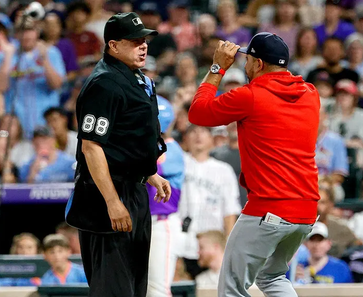
Major League Baseball has reportedly addressed umpire Doug Eddings following a controversial incident involving St. Louis Cardinals pitcher Hancel Rincon, with the league determining that the veteran umpire went too far in the way he handled the young pitcher’s hat during a game against the Colorado Rockies.
The unusual confrontation quickly became one of the weekend’s most talked-about moments around baseball. What began as a seemingly minor issue involving the way Rincon was wearing his cap escalated into a pitch-clock violation, a difficult inning for the rookie pitcher and the ejection of Cardinals manager Oli Marmol.
The incident also prompted a remarkable show of solidarity from players the following day, when members of both the Cardinals and Rockies appeared at the ballpark wearing their caps turned to the side in support of Rincon.
Now, according to a report from Ken Rosenthal of The Athletic, MLB has privately communicated to Eddings that his handling of the situation was inappropriate.
A bizarre moment during Rincon’s MLB debut
The controversy occurred over the weekend as Rincon was making his Major League Baseball debut for St. Louis.
The 24-year-old Dominican pitcher was working against Colorado in the bottom of the sixth inning with one out when Eddings stopped play to address the way Rincon was wearing his hat.
Rincon had his cap positioned at an angle, with the bill turned toward the side rather than facing straight ahead. Eddings apparently believed the way the rookie was wearing the hat could be considered distracting and instructed him to correct it.
What made the exchange unusual was that the issue did not involve Rincon’s pitching mechanics, pace of play, equipment safety or an obvious violation of the rules. Instead, it centered on the appearance and positioning of his cap.
The situation quickly became tense.
Rather than simply allowing play to continue, Eddings lectured Rincon about the hat and ultimately issued the young pitcher a pitch-clock violation.
The decision drew immediate criticism from the Cardinals, particularly because Rincon was appearing in his first-ever major-league game.
The situation spirals out of control
The controversy might have ended with the pitch-clock violation, but the incident became considerably more serious afterward.
Rincon struggled following the confrontation, and what had been a promising major-league debut began to unravel.
The Cardinals’ dugout was also unhappy with how the situation had been handled.
Manager Oli Marmol became involved in the dispute and eventually argued with Eddings. The confrontation resulted in Marmol being ejected from the game.
That transformed what initially appeared to be a minor disagreement over a baseball cap into a much larger story involving the rookie pitcher, his manager and the umpiring crew.
For many observers, the biggest issue wasn’t necessarily whether an umpire has the authority to address a player’s appearance. Instead, it was the manner in which Eddings chose to handle the situation and the consequences that followed.
MLB reportedly believes Eddings crossed the line
According to Ken Rosenthal of The Athletic, MLB reviewed the situation and subsequently communicated its concerns to Eddings.
Rosenthal reported that while umpires have significant discretion when determining whether a player’s actions are distracting, the league believed Eddings’ treatment of Rincon went beyond what was appropriate.
Two people familiar with the matter reportedly told Rosenthal that MLB considered the umpire’s admonishment of the young pitcher to have gone too far.
That is significant because MLB umpires generally have considerable authority over what happens on the field.
They are responsible for maintaining order, enforcing the rules and ensuring that players do not engage in behavior that could interfere with the game.
However, that authority also comes with expectations regarding judgment and professionalism.
In Rincon’s case, the league apparently concluded that Eddings’ response did not strike the right balance.
Players respond with a powerful gesture
The controversy took another turn the following day.
Instead of simply criticizing the umpire publicly, players from both teams appeared to send their own message.
Players from the Cardinals and Rockies reportedly arrived at the next game wearing their hats turned sideways, mimicking the way Rincon had worn his during the disputed incident.
It was an unusual but unmistakable gesture of solidarity.
The players’ decision was particularly noteworthy because it crossed team boundaries. The Cardinals were directly involved in the incident, but Rockies players also participated in the demonstration.
Rather than turning the matter into a prolonged public argument, the players used one of baseball’s simplest pieces of equipment—their hats—to make their feelings known.
The gesture quickly attracted attention from fans and the wider baseball community.
Rincon accepts Eddings’ apology
The story took another step forward when Eddings reportedly apologized to Rincon the following day.
Speaking to reporters, Rincon explained that he did not fully understand everything Eddings had said during the original incident because of the language barrier.
However, Rincon said he understood enough of the conversation the next day to recognize that Eddings was apologizing.
The rookie pitcher also said Eddings wished him well for the remainder of his career.
Rincon responded by indicating that he did not want to hold a grudge over the incident.
He essentially treated the situation as something that happened on the field rather than a personal conflict.
That response from Rincon helped lower the temperature surrounding the controversy.
Questions remain about why Eddings intervened
One of the most curious aspects of the episode is why Eddings became involved with Rincon’s hat in the first place.
When asked about the matter, Eddings reportedly indicated that a Colorado player had raised a concern about Rincon’s hat.
That explanation, however, was disputed by the Rockies.
Colorado reportedly strongly denied that one of its players had complained about Rincon’s hat.
That disagreement has added another layer to the controversy.
If a Rockies player did not actually request intervention, it raises questions about what prompted Eddings to stop the game and address the issue himself.
At the same time, an umpire does not necessarily need a player to make a complaint before intervening. Umpires have authority to address conduct they believe is distracting or inconsistent with the rules.
The central question, therefore, is not simply whether Eddings had the authority to say something.
It is whether the intervention was warranted and whether the manner in which it was handled was appropriate.
The broader issue of umpire accountability
The incident has also reignited a much larger discussion around umpire accountability in Major League Baseball.
Fans regularly criticize umpires for missed calls, inconsistent strike zones and decisions that appear to influence the outcome of games.
One of the recurring frustrations among supporters is the perception that players and managers are held accountable for their mistakes while umpires rarely face comparable public scrutiny.
That is why MLB’s reported response to the Eddings incident is attracting so much attention.
Rather than simply dismissing the controversy as an on-field disagreement, the league reportedly reviewed the situation and communicated to Eddings that his actions crossed an acceptable boundary.
For critics of MLB’s umpiring system, that could be viewed as a small but meaningful indication that the league is willing to address situations in which an umpire’s conduct becomes unnecessarily confrontational.
Why the situation was especially sensitive for Rincon
The fact that Rincon was making his MLB debut made the incident even more awkward.
A player’s first major-league appearance is supposed to be one of the most memorable moments of his career.
For a 24-year-old pitcher who had worked his way through the minor leagues to finally reach baseball’s highest level, the debut represented the culmination of years of work.
Instead of simply concentrating on getting major-league hitters out, Rincon suddenly found himself at the center of a dispute over how he was wearing his hat.
That can be particularly difficult for a young player who is still becoming comfortable at the major-league level.
The mental side of pitching is already challenging. A pitcher must deal with unfamiliar hitters, enormous crowds, television cameras and the pressure that comes with competing in MLB.
Having an unexpected confrontation with an umpire in the middle of that experience only adds another distraction.
The incident could become a learning experience
Despite the controversy, Rincon’s response could ultimately help him move beyond the episode.
The rookie did not appear interested in escalating the situation.
His willingness to accept Eddings’ apology and move forward suggests that he would rather focus on his career than remain caught up in an argument over his hat.
That attitude could serve him well.
Baseball players inevitably encounter disagreements with umpires, managers and opponents. Learning how to handle those moments without allowing them to become distractions is an important part of succeeding at the professional level.
For Rincon, the experience could ultimately become little more than an unusual story from his first MLB appearance.
A strange episode with a lasting message
What began with the position of a rookie pitcher’s hat developed into a much bigger controversy involving an umpire, a manager, two teams and Major League Baseball itself.
Eddings’ decision to intervene led to a pitch-clock violation, Rincon’s difficult stretch on the mound and Marmol’s ejection.
The following day’s sideways-hat demonstration from players on both teams then turned the incident into a visible statement of solidarity with the rookie.
And now, with MLB reportedly telling Eddings that he went too far and Eddings apologizing to Rincon, the league appears to have made its position clear.
Umpires have broad authority on the field, but that authority is not unlimited. They are expected to use their judgment in a way that maintains the integrity of the game without unnecessarily becoming the story themselves.
For Rincon, the best outcome may be to put the strange episode behind him and concentrate on establishing himself as a major-league pitcher.
For Eddings, the incident serves as a reminder that even relatively minor decisions can become major stories when they involve a young player making his MLB debut.
And for MLB, the episode offers another opportunity to address one of baseball’s most persistent debates: where the line should be drawn between an umpire enforcing the rules and an umpire becoming too involved in the game.
Leave a Reply