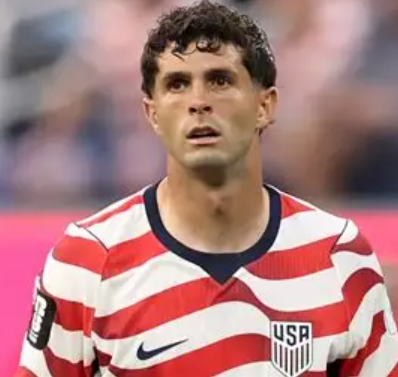
Former U.S. men’s national team striker and soccer analyst Taylor Twellman believes the shortcomings of American college soccer are a major reason the United States continues to struggle on the world stage, arguing that the nation’s biggest athletic conferences have failed to invest in men’s soccer and, in turn, weakened the country’s talent pipeline.
Speaking ahead of the 2026 American Century Championship at Edgewood Tahoe Resort in Stateline, Nevada, Twellman reflected on Team USA’s disappointing 4-1 loss to Belgium in the Round of 16 of the FIFA World Cup earlier this week. While acknowledging that multiple factors contribute to the national team’s struggles, he pointed to the lack of opportunities for young players between the ages of 17 and 21 as one of the sport’s biggest problems in the United States.
According to Twellman, that age range is where elite soccer nations such as France, Spain, England, and Argentina separate themselves from the United States by consistently producing and developing world-class talent.
He explained that countries with successful national teams provide young players with meaningful competitive minutes during those critical developmental years, allowing them to mature into international-caliber professionals. The United States, he argued, has not built a comparable development system.
Twellman noted that America cannot realistically expect to continually produce generational stars like Lionel Messi, Kylian Mbappé, or other global superstars. Instead, he believes the U.S. must develop greater depth by producing multiple high-quality players at every position, rather than relying heavily on a handful of standout talents such as Christian Pulisic, Folarin Balogun, and Weston McKennie.
He also criticized the increasing commercialization of youth soccer, arguing that high participation costs and the pay-to-play model prevent many talented young athletes from accessing elite coaching and competition. In his view, financial barriers continue to shrink the country’s talent pool long before players reach the professional level.
When asked how powerhouse college conferences such as the SEC, Big Ten, ACC, and Big 12 could help improve the situation before the 2034 World Cup, Twellman argued that college athletics must begin treating men’s soccer as a legitimate priority rather than an afterthought.
The SEC currently sponsors only two men’s soccer programs Kentucky and South Carolina which compete in the Sun Belt Conference because the SEC does not sponsor the sport. Similarly, only a handful of Big 12 schools field men’s soccer teams, leaving many of the nation’s largest athletic departments with little direct investment in the sport.
Twellman believes those conferences, which generate billions of dollars through football and basketball while leading college athletics in NIL spending, possess the financial resources to significantly strengthen men’s soccer if they choose to do so.
However, he said the current structure of college soccer is outdated and has failed to evolve alongside other NCAA sports.
He criticized the NCAA for forcing college soccer teams to squeeze more than 20 matches into a three-month season while sports such as basketball, baseball, and football have all benefited from scheduling reforms designed to improve athlete development and competition.
According to Twellman, the compressed schedule limits meaningful training, recovery, and player growth, making it difficult for college athletes to reach their full potential before entering the professional ranks.
Although he acknowledged that reforms are being discussed, he insisted far more changes are necessary.
Twellman also pointed to Title IX as a factor affecting the growth of men’s soccer programs, arguing that universities often cite financial and compliance concerns when deciding against adding or expanding men’s teams. While recognizing the importance of gender equity, he suggested institutions should find ways to support men’s soccer without using Title IX as a reason to limit opportunities.
He emphasized that college soccer still provides tremendous value by allowing athletes to pursue higher education while continuing their athletic development, but only if the NCAA modernizes the sport and gives it the same attention afforded to football, basketball, baseball, and other major collegiate sports.
Twellman further argued that international scouts consistently identify the 17-to-21 age group as the biggest weakness in the American development system. While youth soccer before age 16 has improved considerably, he believes too many promising players fail to receive enough meaningful playing time during the years that matter most for professional development.
To illustrate his point, Twellman referenced English Premier League star Jamie Vardy, whose unconventional path to stardom would likely not have been possible within the current American soccer system. He suggested that many late-developing talents in the United States are overlooked because opportunities are too limited and the developmental structure is too rigid.
Ultimately, Twellman warned that unless college athletics, conference leaders, university administrators, and youth soccer organizations commit to expanding opportunities, increasing investment, and modernizing player development, the United States risks facing the same frustrations at future World Cups in 2030, 2034, and beyond.
He believes meaningful reform at both the collegiate and grassroots levels is essential if Team USA hopes to compete consistently with the world’s elite soccer nations.
Leave a Reply