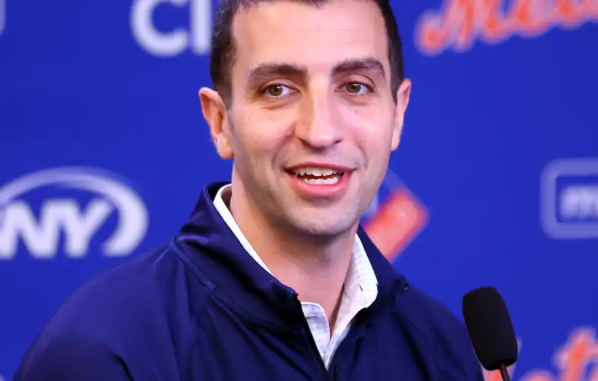
The New York Mets’ frustrating 2026 campaign has sparked widespread debate about the future of the organization, with many fans questioning whether President of Baseball Operations David Stearns should be held accountable for the club’s struggles. However, Mets owner Steve Cohen appears committed to staying the course, signaling that his confidence in Stearns remains intact despite one of the most disappointing seasons of his ownership era.
The conversation intensified following the dismissal of manager Carlos Mendoza, a move that immediately shifted attention toward the front office. As the Mets entered July with a disappointing 36-50 record and found themselves buried in the National League East standings, speculation grew regarding whether Stearns could be the next high-profile figure to lose his job.
Cohen quickly put those rumors to rest.
According to reports, the billionaire owner has no plans to part ways with Stearns before the completion of his original five-year contract, which runs through 2028. While Cohen acknowledged that significant changes are necessary if the Mets hope to return to contention, he made it clear that replacing the team’s chief baseball executive is not currently under consideration.
At first glance, that level of support may seem surprising given the club’s underwhelming performance. Expectations were high entering the season, particularly after the Mets continued their aggressive spending approach and attempted to build a roster capable of competing for a championship. Instead, the team has struggled for consistency, fallen out of the playoff race, and failed to meet the lofty standards established by ownership.
Yet Cohen’s loyalty to Stearns is rooted in more than just patience.
Long before joining the Mets, Stearns was regarded as one of baseball’s most respected executives. During his tenure with the Milwaukee Brewers, he developed a reputation for maximizing limited resources, consistently fielding competitive teams despite operating with payrolls that were significantly smaller than many of their rivals. Under his leadership, Milwaukee transformed into a perennial contender, capturing division titles and making multiple postseason appearances.
His success in Milwaukee made him one of the most sought-after executives in the sport, and Cohen spent years pursuing him before finally bringing him to Queens. The owner viewed Stearns as the long-term architect capable of stabilizing a franchise that had experienced years of front-office turbulence and organizational inconsistency.
That instability cannot be overlooked when evaluating the current situation.
Before Stearns arrived, the Mets cycled through several executives and front-office structures, creating an environment where long-term planning often took a back seat to short-term fixes. The organization struggled to establish continuity, and frequent leadership changes prevented the development of a consistent vision.
One of Stearns’ greatest contributions so far may be providing that stability.
While many of his roster decisions this past offseason have come under heavy scrutiny, particularly moves involving veteran acquisitions that have failed to deliver expected results, Cohen appears to believe that one disappointing season should not erase years of proven success. The owner seems convinced that Stearns deserves the opportunity to correct mistakes rather than becoming another casualty of the franchise’s revolving door of executives.
There is also a practical side to the decision.
Replacing Stearns would require another leadership transition at a time when baseball faces potential labor uncertainty and economic questions surrounding future league operations. Bringing in a new executive would mean restarting the organizational process yet again, forcing another front-office leader to inherit a flawed roster while simultaneously trying to navigate immense pressure to win immediately.
That challenge becomes even greater considering the presence of superstar Juan Soto and the organization’s desire to maximize its championship opportunities during his prime years. A new executive would need time to evaluate the roster, establish relationships, and implement a vision—time that a win-now franchise may not feel it can afford.
For Cohen, continuity may represent the safest and most logical path forward.
The Mets owner undoubtedly understands the frustration surrounding the team’s performance, but he also recognizes that sustainable success rarely comes from constant organizational upheaval. While Stearns deserves criticism for many of the decisions that contributed to the club’s disappointing season, Cohen appears willing to give him the chance to fix the problems rather than starting over once again.
Whether that faith is ultimately rewarded remains to be seen. The remainder of Stearns’ tenure may now be defined by his ability to repair a roster that has fallen far short of expectations and restore the Mets to relevance in a highly competitive National League.
For now, however, Steve Cohen is making one thing clear: despite the criticism, despite the disappointing results, and despite growing pressure from the fan base, David Stearns still has the owner’s trust—and likely several more years to prove that trust is justified.
Leave a Reply