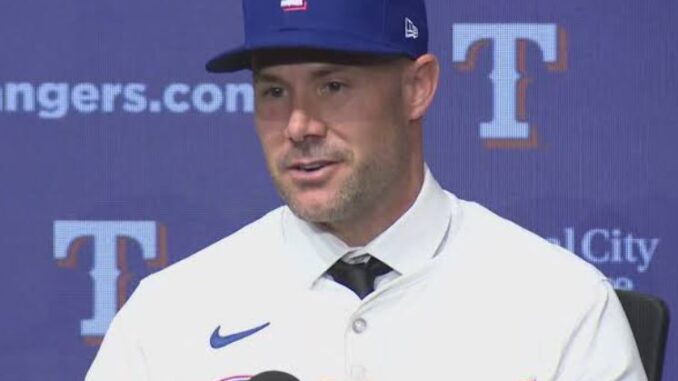
The Chicago Cubs’ blockbuster acquisition of Pete Crow-Armstrong continues to look better with every passing season, but one of the lesser-known players involved in that 2021 deal has now resurfaced in the major leagues. Veteran right-hander Trevor Williams, who was included in the trade that sent Javier Báez and Williams from Chicago to the New York Mets in exchange for Crow-Armstrong, has signed a major-league contract with the Texas Rangers just in time for the final month of the 2026 regular season.
Williams’ agreement with Texas came on the final day of August, which is particularly significant because it makes him eligible for the postseason should the Rangers qualify. The late move gives Texas another experienced arm for the stretch run while providing Williams with an opportunity to return to a major-league roster after being released by the Washington Nationals late in August.
The 34-year-old pitcher had spent much of the season working out of Washington’s bullpen after returning from a lengthy absence caused by UCL surgery. Rather than being used strictly as a traditional one-inning reliever, Williams provided the Nationals with valuable multi-inning work. He recorded a 2.65 ERA across 17 innings, while averaging close to 12 strikeouts per nine innings. His ability to cover multiple frames without immediately exhausting a bullpen made him an attractive option for a Texas team looking for additional pitching depth.
Williams’ first appearance with the Rangers, however, was not the ideal introduction. He surrendered three earned runs over 1⅓ innings against the Athletics, a reminder that the veteran will need to regain his consistency quickly if Texas intends to rely on him during the stretch run.
For Cubs fans, Williams’ latest move is notable for an entirely different reason. His name is permanently connected to one of the most consequential trades in recent Chicago history because he was part of the package that helped the Cubs acquire Crow-Armstrong from the Mets.
At the time of the 2021 trade deadline, the deal was largely viewed through the lens of Báez and Crow-Armstrong. Báez was the established major-league star heading to New York, while Crow-Armstrong was the highly regarded prospect Chicago received in return. Williams was effectively the secondary piece, and his inclusion in the transaction received relatively little attention.
Five years later, however, the trade has taken on a dramatically different meaning.
Crow-Armstrong has developed into one of the most important players on the Cubs’ roster and one of the most exciting young players in baseball. In 2026, he has taken another major step forward offensively and defensively, strengthening his case as one of the National League’s premier players. His spectacular season includes a three-home-run, six-RBI performance against the Cincinnati Reds on August 29, when Chicago rolled to a 17-5 victory. That explosion pushed his home-run total to 36 at the time and further fueled discussion about his place in the National League MVP race.
Crow-Armstrong’s development has been particularly impressive because he was originally viewed primarily as a defensive-minded center-field prospect. His speed, range and throwing ability were already considered elite, but his offensive development was less certain. Over time, he has transformed himself into a legitimate middle-of-the-order threat, adding significant power while improving his overall approach at the plate.
The Cubs clearly recognize how valuable he has become. Earlier this year, Chicago agreed to a six-year, $115 million contract extension with Crow-Armstrong, locking up its star center fielder through the 2032 season. The agreement underscored the organization’s belief that he can remain a cornerstone of the franchise for years to come.
That contract also provides an interesting contrast with where the Cubs were when the original trade occurred. Chicago was in the process of dismantling an aging championship core in 2021, with Báez, Kris Bryant and Anthony Rizzo all eventually departing as the organization began rebuilding around younger talent.
Crow-Armstrong ultimately became one of the biggest beneficiaries of that organizational reset.
Williams, meanwhile, had his own productive stretch after leaving Chicago. He made 30 appearances for the Mets in 2021, including nine starts, and posted a 3.21 ERA after joining New York. That performance helped him secure a two-year contract with the Nationals, allowing him to continue his career as a versatile pitcher capable of working both as a starter and reliever.
His path since then has been considerably more complicated. Injuries, including his UCL surgery, interrupted his career and forced him to work his way back to the majors. His return with Washington demonstrated that he could still be effective, particularly when used as a multi-inning reliever, but the Nationals ultimately released him in late August.
Texas’ decision to sign him therefore represents more than simply a depth move. The Rangers are trying to maximize their pitching options for the closing weeks of the season, and Williams brings experience, versatility and the ability to absorb innings without necessarily requiring a traditional starter’s workload.
The signing also provides an intriguing footnote to the Crow-Armstrong trade. While Williams may not have been the centerpiece of the transaction, his presence was part of the chain of events that ultimately brought one of baseball’s emerging stars to Chicago.
The original trade is now increasingly regarded as one of the defining moves of the Cubs’ recent rebuild. Crow-Armstrong has gone from highly touted prospect to All-Star-caliber center fielder and has continued to elevate his game in 2026. Meanwhile, Báez’s tenure in New York became a separate chapter of the Mets’ history, and Williams has continued bouncing between organizations while carving out a long major-league career.
For Williams, the last-minute agreement with Texas gives him another opportunity to contribute at the highest level. For the Cubs, his signing is a reminder of just how dramatically the original trade has aged.
A player who was largely forgotten when the Cubs acquired Crow-Armstrong is now back in the spotlight with the Rangers, while the prospect at the heart of the transaction has developed into a franchise centerpiece. Five years after the deal, Crow-Armstrong’s rise has made the trade look increasingly lopsided in Chicago’s favor, and Williams’ late-season return to the majors adds another unexpected chapter to that story.
Leave a Reply